
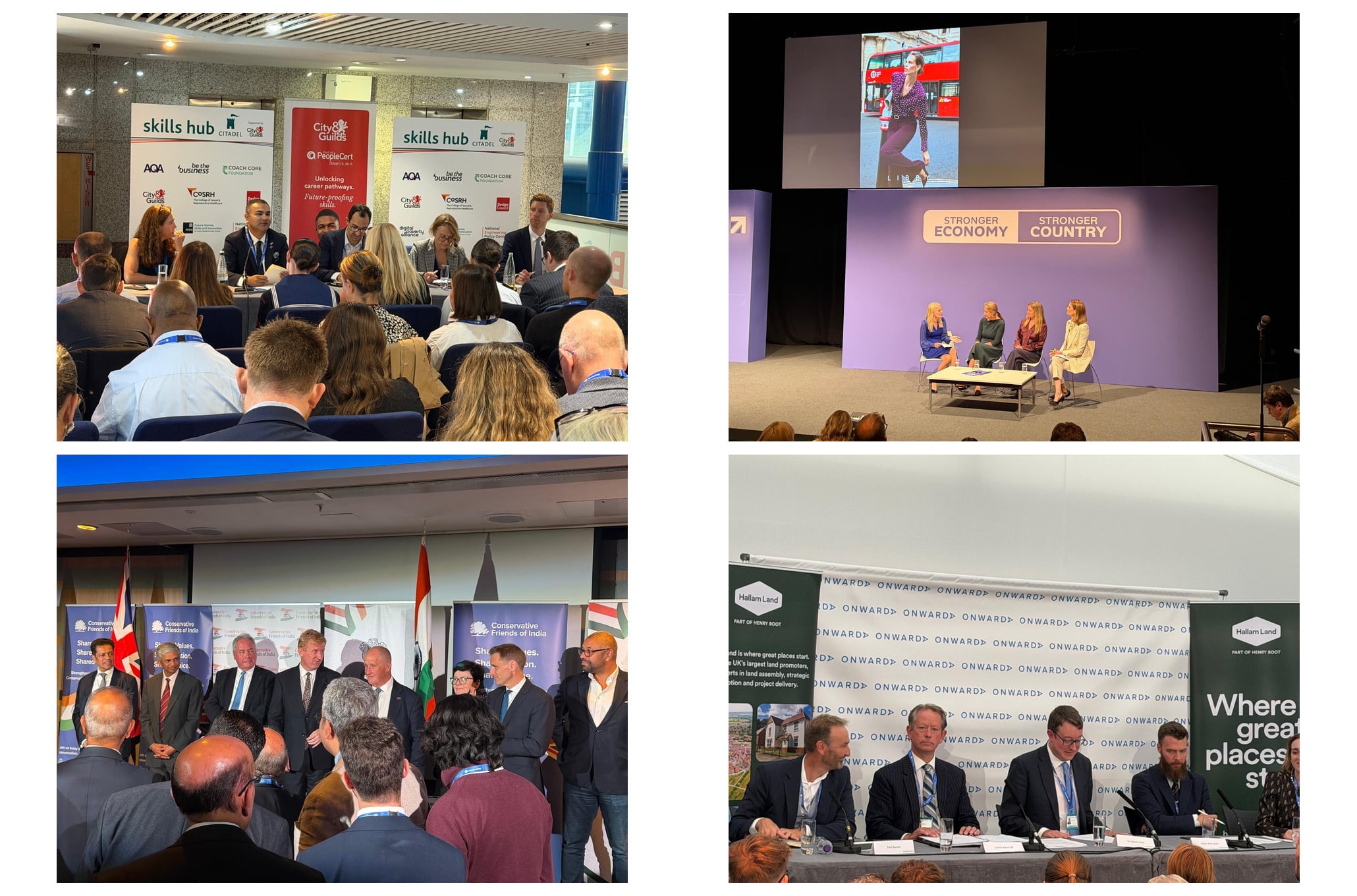
Reflections from party conferences 2026
by Shomik Panda on 15 Oct 2026
I recently returned from another round of annual party conferences, this year taking in Labour, Conservatives and Reform UK. What was striking was the palpable change in mood across the main parties and the emergence of significant dividing lines between left and right. Here are some reflections on what was announced and where things are heading on the main issues for businesses.
Mood and momentum shifts back towards traditional parties
Twelve months is a long time in politics. This time last year the fringe parties (Reform UK and the Green Party) were in the ascendancy and the main centrist parties (Labour and Conservatives) were in the doldrums. Fast forward a year and Reform UK and the Greens have been diminished by ongoing donation scandals and entryism, respectively; meanwhile, the country’s third-largest party, the Liberal Democrats, are openly talking about replacing their leader, Ed Davey. Conversely, Labour is resurgent under new leader PM Andy Burnham; and the Conservative Party, while still lagging in the polls, has freshened up its front bench and is starting to cut through under its leader, Kemi Badenoch.
As ever, the mood in each conference tended to broadly reflect this wider backdrop. The Greens and Lib Dems emerged from their conferences looking more divided than before. Both of their party leaders look vulnerable and could be replaced ahead of the next election.
Reform UK hosted a bigger conference than ever. Business attendees were comfortable with the party’s instincts on tax and regulatory reform, yet Reform struggled to convince the business audience that it has a sufficiently detailed policy agenda and is ready to govern. Activists were upbeat despite the various scandals besetting the party; but rumours of in-fighting within the top team, and questions over Nigel Farage’s willingness to stay the course as leader, loomed large. It was hard to escape the feeling that Reform may have peaked too early in this electoral cycle.
By contrast, the Labour conference in Liverpool fizzed with energy as politicians, interest groups and business representatives descended en masse to get a feeling for the new direction of the party under Andy Burnham, appointed as prime minister in July. Mayors and councillors were visible and enjoying the looming prospect of powers being devolved to them. Businesses may not have had quite the reassurances they hoped for ahead of the October budget, but engagement was markedly improved from a year ago. A sense of optimism among activists, following the change in leadership, was palpable.
The Conservative conference was not well-attended, a likely reflection of the party’s position in the polls. And yet the mood was upbeat. For the first time in recent memory, there was a strong sense of unity within the party — and excitement among members — driven by a combination of a return to traditional conservative policies and the emergence of a fresh-faced and energetic new top team, led by an increasingly confident Kemi Badenoch.
Tech policy takes a back seat
This year’s conference season was lighter on tech policy announcements than previous years. The policy focus was firmly on AI, and especially its impact on ordinary workers. A £100-million skills and training support package was announced by the Chancellor: to focus on local apprenticeships and upskilling programs in order to ensure workers are not left behind. The Labour government also reiterated that the UK will place AI safety and management at the heart of its 2027 G20 Presidency, to serve as a leading vehicle for establishing a new global code for AI. Soon after the conference, Prime Minister Burnham separately announced legislation to curb non-compete hiring clauses preventing employers’ restricting workers from moving jobs. This had been a long-standing ask of the tech sector: the change will make it much easier for startups and scale-ups to recruit top talent.
Elsewhere, the Conservatives spoke of favouring proportionate AI regulation over strict bans. But with a new shadow AI minister in post, it has yet to fully develop its plans. Reform UK pledged to scrap the UK General Data Protection Regulation (GDPR). The Lib Dems called for stronger domestic regulation of major technology companies and also promised to propose an ‘‘online crime levy’’ on large technology and AI firms in order to fund a specialist law enforcement body.
Dividing lines emerge over tax and expenditure plans
The starkest policy divisions concerned business and personal taxation. The Labour Party, recently under pressure from the bond markets, faces a tough Budget at the end of this month and was tight-lipped about its plans. The Chancellor re-committed Labour to not increasing the main rates of income tax, VAT or employee National Insurance contributions — but also signalled his intent to curb welfare spending by transitioning the state pension from the current ‘‘triple lock’’ to an ‘‘annual double lock’’ starting in April 2030. More interestingly, on the conference floor Labour delegates quietly passed a non-binding policy motion for the party to introduce a wealth tax, a windfall tax on banks, an end to income tax threshold freezes and an overhaul of business rates for high-street retailers. How much of this makes it into the Budget is an open question.
The Greens also re-iterated previous calls for a wealth tax in the form of an annual charge on total asset value of the ultra-wealthy and a windfall tax on the domestic retail banking profits of the UK’s largest banks. The Liberal Democrats committed to raising the personal tax-free allowance to £15,000 and the 40p higher-rate income tax threshold from £50,270 to £56,000; the party also passed a motion to cut red tape for small and medium-sized enterprises (SMEs), which would include reinstating the Office of Tax Simplification as well as altering R&D and founder tax reliefs to prevent start-ups' leaving the UK.
Parties on the right, conversely, used their conferences to promote a business-led growth agenda and a series of personal tax cuts. The Conservatives pledged to halve Employer National Insurance contributions for workers aged 21 to 24, completely abolish inheritance tax on family homes, and raise the base individual tax-free allowance from £325,000 to £500,000. They also outlined a plan to scrap Labour’s packaging tax and simplify the tax code by replacing IR35 rules. And Badenoch announced a “golden rule on fiscal responsibility”: by which at least 50% of state administrative savings must go directly toward deficit reduction, with the rest funding targeted tax cuts. Reform UK pledged to raise the personal income tax allowance to £15,000; raise the VAT registration threshold from £90,000 to £150,000; and scrap income tax altogether on overtime hours.
Left and right also divide over Europe
While Labour has edged closely towards closer co-operation with the EU, one the bigger surprises of this year’s conference was the prime minister’s EU “reset’’: ie, his declaration that Brexit had done more harm than good and that the government would be formally reviewing options for the UK’s long-term relationship with Brussels. The PM laid out four options for the British public to consider:
- Maintaining the current Trade and Cooperation Agreement (TCA);
- A Customs Union Model;
- Single Market Membership;
- Pursuing full membership to re-enter the European Union as a whole.
These four options would be debated before one is chosen to form the basis of Labour’s manifesto in its campaign for another government mandate. EU officials I spoke to had a clear line: they would work with whatever direction the UK chooses to go. In the meantime, the upcoming UK-EU Summit will maintain a narrow focus on deals regarding cross-border energy sharing, a veterinary/sanitary agreement for food and drink trade, and youth mobility schemes.
The Lib Dems stated at their conference that they would return the UK to the European Single Market. The Greens have a longer-held position to rejoin the EU as a full member as quickly as possible. For the first time since Brexit, this means that left and centre-left parties are united in wanting to renegotiate the UK’s post-Brexit relationship with the EU.
The right, on the other hand, remains united on not wanting to renegotiate the UK-EU relationship. Badenoch called Labour’s plans to reopen the Brexit debate a ‘‘terrible idea’’. Both the Conservatives and Reform oppose any renegotiation and retain their plans to withdraw the UK from the European Convention on Human Rights (ECHR).
Implications
The 2026 conference season has drawn a clear line in the sand between parties of left and right. The next election will likely be fought over divergent fiscal and European policies. The momentum is now again with the traditional stalwarts: Labour and the Conservative parties.
On the right, the Conservatives that are the main beneficiary as Reform tries to extricate itself from ongoing scandals which are cutting through to the public consciousness. Badenoch has put together a new shadow team almost unknown to the public as she seeks to ‘‘rebrand’’ and distance her team from recent Conservative governments. A series of popular ‘‘retail’’ tax policies that are easy for voters to understand — such as the abolition of stamp duty, inheritance tax and the removal of the £100,000 childcare cliff-edge — means the Conservatives may be back in contention at the next election.
Labour has a difficult Budget ahead; how long the recent ‘‘Burnham bounce’’ may last remains an open question. The party’s positioning on Europe exposes it to longer-term political difficulties, though in the short term this may be smart politics. As the Lib Dems and Greens consider their direction, Labour is well placed to consolidate the votes of the left. Between Conservative, Reform and Restore, the right is currently more fragmented than the left, handing Labour an electoral advantage. But the prime minister will be wary of a Conservative Party again on the march. If Burnham can maintain his popularity into next year, he may judge it to be an auspicious time to go back to the electorate before his likely biggest threat has yet to fully re-emerge.
Topics: UK politics, Regulation, Technology, Politics, Innovation





Comments